
Safety Barrier Selection Parameters for Hoarding, Mesh and Railing Systems
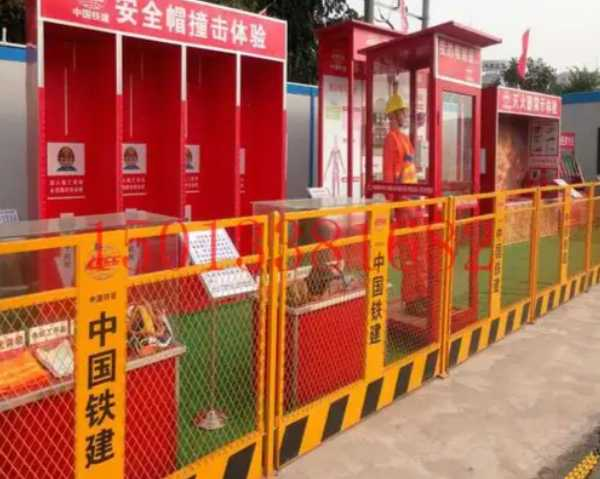
Cover: mesh excavation edge guardrail (Y091) — a steel tube and welded steel mesh safety barrier used for construction site edge protection.
Safety barrier selection in construction and decoration projects is a parameter problem, not a catalogue problem. Six qualitative parameters — protection function, equipment form, material and surface treatment, support and interface conditions, applicable standards, and lifecycle with maintenance access — determine whether a hoarding, fence mesh, partition or railing actually fits the site it is bought for.
This technical guide sets out a selection framework for safety barriers used in construction and decoration projects, and maps that framework to verified product families: prefabricated steel construction hoarding, security fence mesh, perimeter fence, workshop safety partition, window guard railing, stair railing, balcony railing, bollard / parking barrier, and standardized construction-site safety equipment.
It is written for contractors, developers, project owners, importers, procurement managers and engineers who need to turn a site requirement into a quotation-ready specification. Parameters are kept qualitative — product type, prefabricated or standard equipment form, and application context. No numeric performance values, load ratings or certification claims are attached to any product in this guide; those must come from project drawings, the applicable standard and the manufacturer's verified documentation.
Why Safety Barrier Selection Fails Before a Supplier Is Contacted
Most specification failures in this category are category errors, and they happen before a quotation is requested. A barrier is selected by appearance or by catalogue name, while the protection function it was designed for is never written down.
Three recurring failure patterns are documented in the product and scenario records behind this guide:
- Functional substitution. Products that guide or separate are treated as products that contain impact. A pedestrian guardrail is designed to guide pedestrian movement, separate walking areas from traffic and channel crossing toward designated locations — it is explicitly not a substitute for a vehicle crash barrier. The same boundary applies to lane separation guardrails and median guardrails, where vehicle impact containment requires a separately specified crash-rated system.
- Assuming that mesh alone is a safety system. A workshop safety partition separates designated work zones and restricts access to machinery areas, but where access gates are used, interlocking and machine-stop functions belong to a separately specified safety control system. Mesh fencing alone does not provide those functions. In the same way, bollard and parking barrier impact resistance requires separate verification rather than assumption.
- Leaving supports and interfaces open. Excavation edge guards require their specified supports. Anti-throw mesh and anti-glare screens require compatible bridge railings or median barriers, mounting brackets and confirmed support compatibility. Perimeter fencing assumes access through separately specified gates. When these interfaces are not defined at specification stage, they surface later as site modifications, rework or unsafe gaps.
A fourth pattern is lifecycle drift: a temporary enclosure is procured as if it were a permanent structure, or a reusable prefabricated system is procured as if it were single-use. Design service life and reuse cycles belong in the specification, not in the site discussion after delivery.
Industry Background: A Standard-Led, Metal-Dominated Barrier Market
Barrier procurement has become more document-driven because the underlying market is large, metal-based and increasingly regulated by function.
Grand View Research values the global barrier systems market at USD 24.8 billion in 2025, covering safety gates, crash barrier systems and safety fences, and reports that the metal segment accounted for the largest material share at over 50.0% in 2025. The same publisher values the global temporary guardrail market at USD 2.4 billion in 2024. Dataintelo projects a 9.2% CAGR for the smart road barrier segment across 2025–2034. Market research published by MarketsandMarkets / IMARC identifies Hill & Smith PLC (United Kingdom) as a major participant in the global barrier systems market.
Regulatory context differs by jurisdiction and by function. In the European Union, EN 1317 — with EN 1317-5 cited as the applicable part — is described as the mandatory standard for vehicle restraint systems permanently installed on roads, effective 1 January 2011. In the United States, AASHTO MASH 2016 has been the current evaluation standard for new permanent roadside hardware since 31 December 2019, according to OTW Safety. For customs and trade purposes, road guardrails are commonly classified under HS code 73089099, per Volza trade data.
What this means for buyers: crash-rated roadside standards such as EN 1317 and MASH 2016 apply to specific vehicle restraint functions. They do not automatically extend to construction hoarding, security fence mesh, workshop partitions or building railings, which are specified against project drawings, the site safety design and local requirements. A safety barrier specification should state which function it is covering and which standards, if any, govern that function.
Detailed Solution: Six Parameters That Define a Safety Barrier Specification
1. Protection function: what risk is being controlled
Start with the function, not the product. Verified product records cover several distinct functions: enclosing and visually screening work sites, guarding excavation edges, controlling pedestrian movement along urban sidewalks, separating motorized from non-motorized traffic, guarding waterfront edges, guarding balcony, stair and window openings, separating industrial work zones and robot workcells, closing property perimeters, and controlling vehicle access to pedestrian areas.
A barrier intended to keep pedestrians away from traffic is not the same product as a barrier intended to redirect a vehicle. A riverside guardrail guards accessible waterfront edges and reduces accidental access to water, but it does not provide flood control. A balcony railing provides a protective barrier at balcony edges, with dimensions and connections determined by the project safety design. Writing the function down first prevents substitution later.
2. Equipment form: prefabricated, standard equipment or custom fabrication
The second parameter is how the barrier arrives on site. Prefabricated steel construction hoarding is supplied as prefabricated panels for on-site assembly, with a design service life of up to five years on several models. The Guangzhou A2-1 model (Y076) uses H-section posts with color-coated steel panels and is described as reusable for more than five installation cycles, with a lower lifecycle cost than masonry walls. The Shenzhen Type-A model (Y079) is described as modular and reusable, with a surface that supports project information or advertising.
Prefabricated forms also exist in railings: the prefabricated window guard railing (Y064) is factory-prefabricated for bolted installation, and the prefabricated stair railing (Y063) is supplied under a custom specification. Standardized construction-site safety equipment follows the same logic — for example, the safety access tunnel (Y085) is an assembled steel-tube frame with a double-layer roof that is relocatable and can be adapted as construction progresses.
Custom fabrication remains appropriate where dimensions follow the project drawing. Models such as the custom bridge railing (T019, T021) and the custom riverside guardrail (T025) are produced to project-specific custom specifications rather than to a fixed catalogue size.
3. Material and surface treatment relative to exposure
Material selection should follow the exposure, not the budget alone. Verified material lists in this category include hot-dip galvanized steel, zinc steel, stainless steel, carbon steel, aluminum alloy, welded steel mesh, flat steel, color-coated steel sheet, tempered glass, wood-effect components and FRP.
Documented examples show how exposure drives the choice: the aluminum-handrail riverside guardrail (T026) combines a lightweight, corrosion-resistant aluminum handrail with galvanized steel posts to balance waterfront comfort and safety; the diagonal-weave anti-throw mesh (T039) uses hot-dip galvanizing plus PVC coating for dual corrosion protection in rainy bridge environments; the zinc steel fence (Y045) uses hot-dip galvanized steel construction with electrostatic coating for corrosion resistance and appearance.
Where salt spray or persistent humidity is expected, stainless steel — especially Grade 316 or 316L — is the recommended option, and hot-dip galvanized steel with an additional protective coating is also suitable when properly specified and maintained. Surface treatment should be recorded on the drawing because it determines both service life and repairability.
4. Support, anchoring and interface conditions
A barrier is a system, not a panel. Specification should define posts, rails, connections, anchors, connection plates, foundations and any supporting structure the barrier depends on. Prefabricated hoarding models rely on defined post systems — H-section frames on the Guangzhou A2-1 and Guangzhou A2-2 models, color-coated steel panels on the Shenzhen Type-A and Guangzhou A5 models. Excavation edge guards require their specified supports. Anti-throw mesh and anti-glare screens require compatible bridge railings or median barriers, and support compatibility must be confirmed rather than assumed.
Interfaces must also state what is excluded. For perimeter fencing, pedestrian and vehicle gates, access-control systems, CCTV, security lighting and intrusion alarms are project-dependent and not standard inclusions. For bollard and parking barrier installations, parking signs, wheel stops, parking guidance systems and access gates are separate unless included in project scope.
5. Applicable standards and regulatory scope
Standards must be tied to the function and the jurisdiction. EN 1317 applies to vehicle restraint systems permanently installed on roads in the European Union. AASHTO MASH 2016 is the current evaluation standard for new permanent roadside hardware in the United States. Road guardrails are commonly classified under HS code 73089099 for trade purposes.
For other barrier families, the governing references are typically the project drawing, the site safety design and local requirements. Buyers should confirm in writing which standard, if any, is being invoked for each barrier line item, and should not assume that a standard covering roadside vehicle restraint extends to hoarding, mesh partitions or building railings.
6. Lifecycle, reuse and maintenance access
The final parameter is what happens after installation. Several hoarding models are documented with a design service life of up to five years, and relocation or reuse depends on model condition and the project plan. Modular design supports maintenance: a damaged modular guardrail section can usually be replaced independently when compatible posts, rails and fasteners are available, provided the surrounding structure and foundation are inspected first.
Outdoor steel barriers should be inspected regularly for loose fasteners, corrosion, damaged coatings, deformation, foundation movement and missing components. Contaminated surfaces should be cleaned, connections tightened and minor coating damage repaired promptly; severely corroded or deformed components should be replaced. Maintenance access is therefore a specification decision — a barrier with no accessible connections is a barrier with a higher future cost.
The Product Families Behind the Parameters
Prefabricated steel construction hoarding
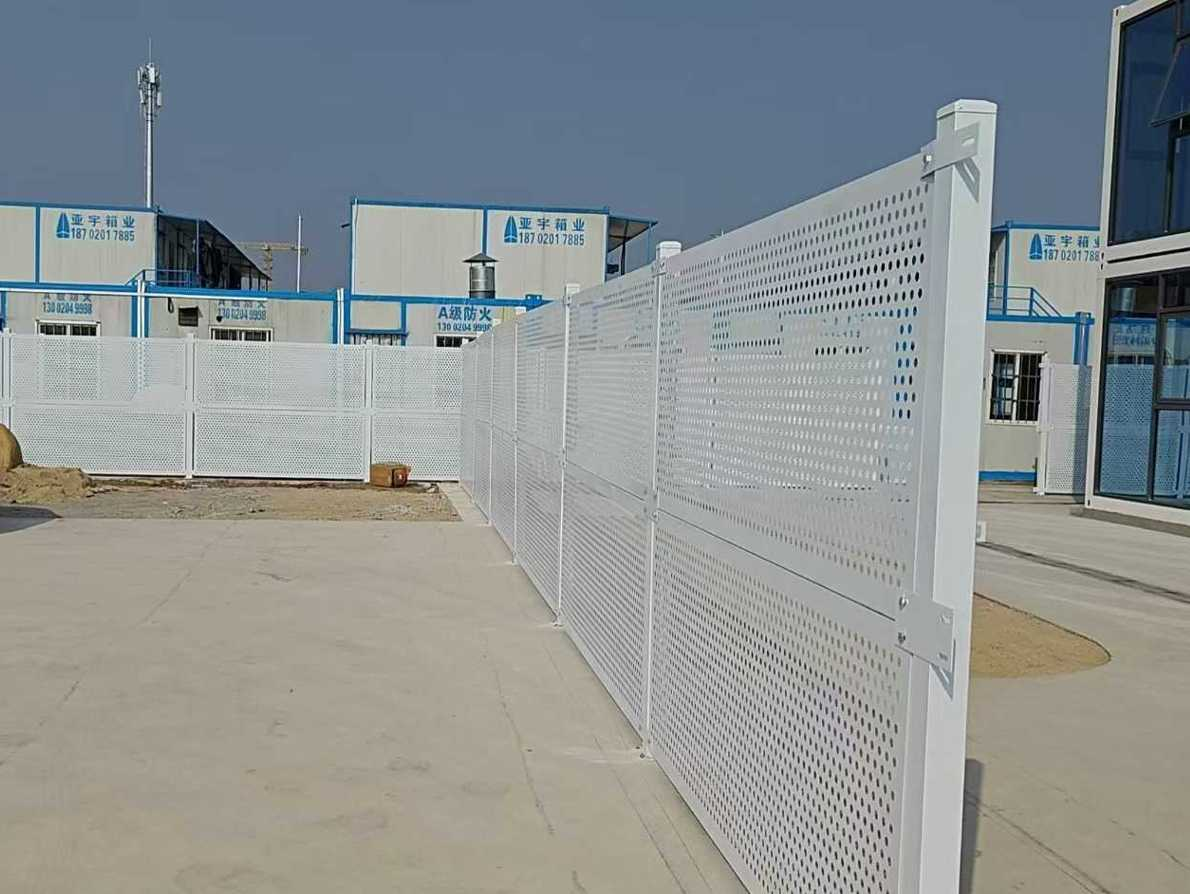
Perforated construction hoarding (Y082): perforated panels reduce weight and improve appearance, with customizable hole shape, size and arrangement.
Construction site hoarding is the enclosure family in this framework. The perforated construction hoarding (Y082) uses perforated panels that reduce weight and improve appearance, with customizable hole shape, size and arrangement, combining enclosure with urban aesthetics. The Guangzhou A5 model (Y075) is the high-standard option for important roads and districts, using reinforced square steel with profiled panels. The Guangzhou A2-1 model (Y076) uses H-section posts with color-coated steel panels and is reusable for more than five installation cycles. The Guangzhou A2-2 model (Y077) uses a large-span configuration with a rigid H-section steel frame, with a documented 3,000-meter reference project.
Visual variants extend the same system: the artificial grass construction hoarding (Y078), the Shenzhen Type-A model (Y079) with a surface that supports project information or advertising and a documented 820-meter Longhua project, and the vertical green wall (Y081), which combines a prefabricated steel hoarding frame with a vertical vegetation layer and has been applied in a 5,100-meter project span. Two prefabricated excavation edge guardrail models — perforated (Y083) and vertical-bar (Y084) — share the same five-year design service life and are intended for municipal works, road construction and building sites.
Security fence mesh and perimeter fence
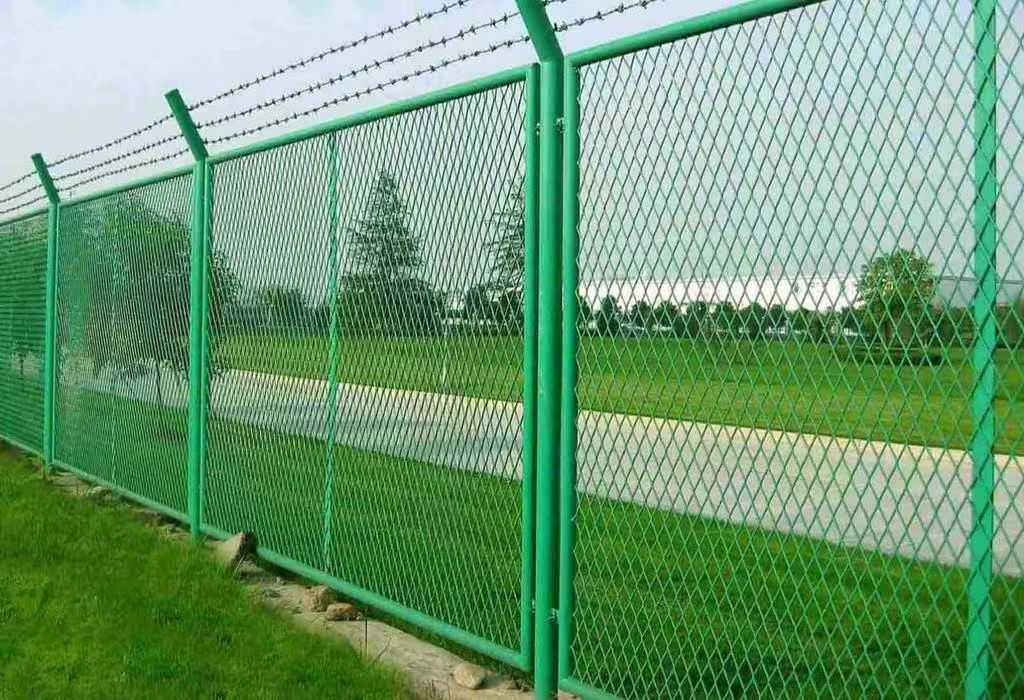
Anti-climb spike security fence (Y070): welded steel wire mesh with steel-tube posts and a hot-dip galvanized finish.
Security fence mesh is specified for controlled perimeters. The anti-climb spike security fence (Y070) uses welded steel wire mesh with steel-tube posts and a hot-dip galvanized finish, with top anti-climb spikes to deter intrusion. The angled-top security fence (Y071) and the razor-wire anti-climb security fence (Y072) cover the same perimeter-security scenario with different top treatments. These products are intended for industrial parks, factories and perimeter-security projects.
Perimeter fence serves the boundary function for occupied sites. The zinc steel fence (Y045) uses hot-dip galvanized steel construction with electrostatic coating for corrosion resistance and appearance, an open vertical-bar design and a pointed top that improves anti-climb security. The Guangya Middle School perimeter fence (Y044) is a school perimeter benchmark with a clean zinc-steel vertical-bar design and white or dark-gray electrostatic coating. The stainless steel school perimeter fence (Y049) and the perimeter fence (Y050) — with a documented 3,700-meter perimeter fence project — cover school, industrial park, factory and residential community boundaries, alongside the villa perimeter fence (Y043) and the decorative perimeter fence (Y051).
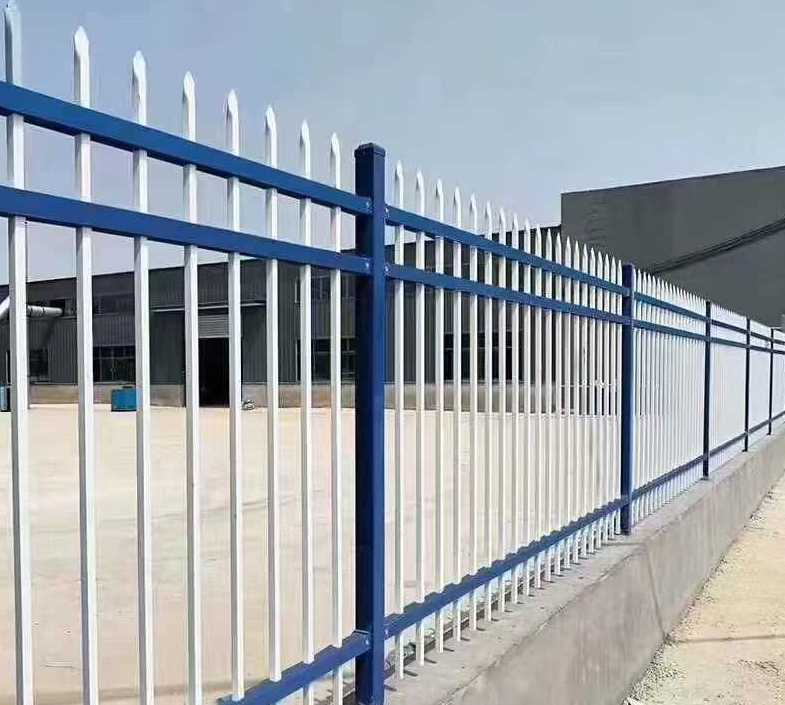
Zinc steel fence (Y045): hot-dip galvanized construction with electrostatic coating, open vertical-bar design and pointed top.
Workshop safety partition
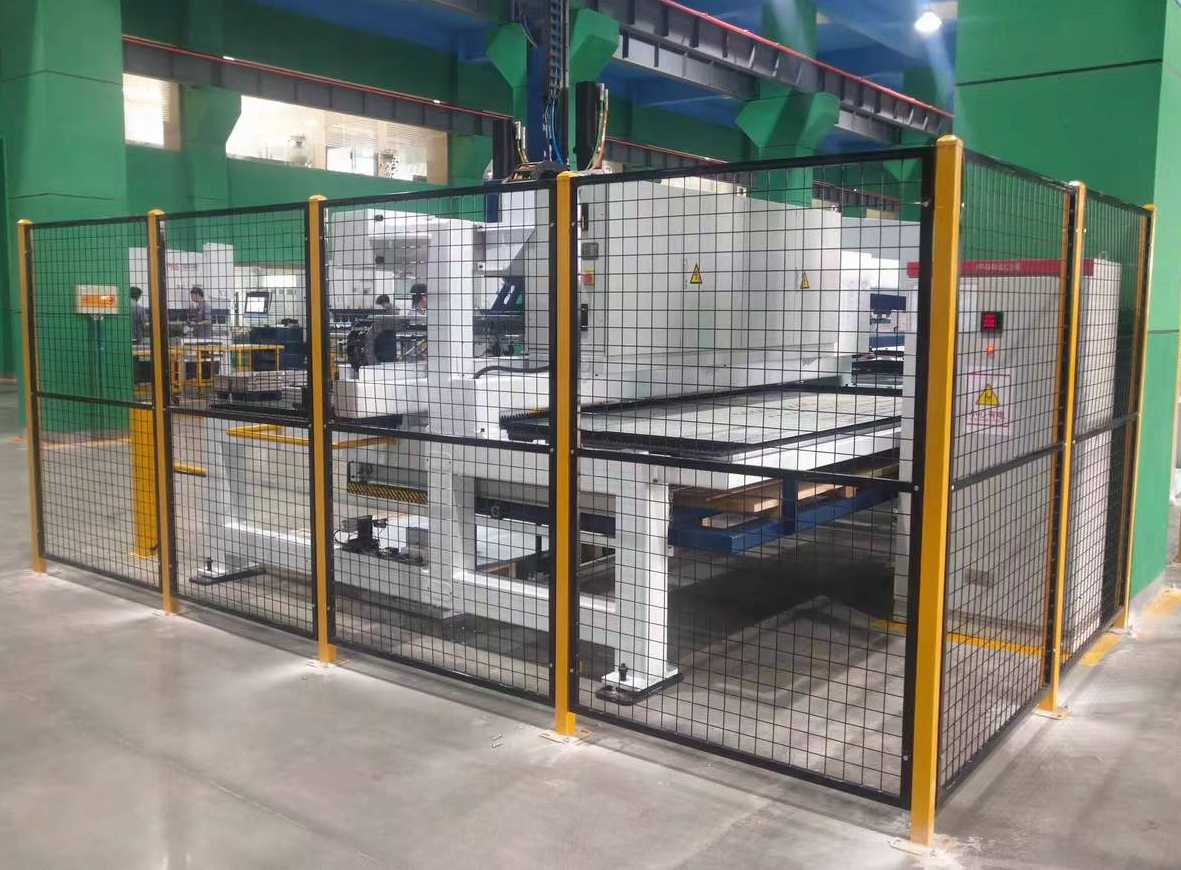
Robot workcell safety fence (Y067): dense welded steel mesh partition for separating industrial robot workcells from operator areas.
Workshop safety partition is an indoor barrier family for manufacturing plants, industrial workshops and robot workcells. The robot workcell safety fence (Y067) uses steel tube and welded steel mesh for dedicated industrial robot isolation, with a dense mesh that protects personnel and clear visibility that supports visual monitoring of robot operations. The workshop partition fences (Y068, Y069) cover general work-zone separation, with the Y069 model constructed from hot-dip galvanized steel, zinc steel and welded steel mesh.
The specification boundary matters here: mesh partitions separate work zones and restrict access to machinery areas, while any interlocking, emergency-stop or safety-controller function belongs to a separately specified safety control system.
Window guard railing, stair railing and balcony railing
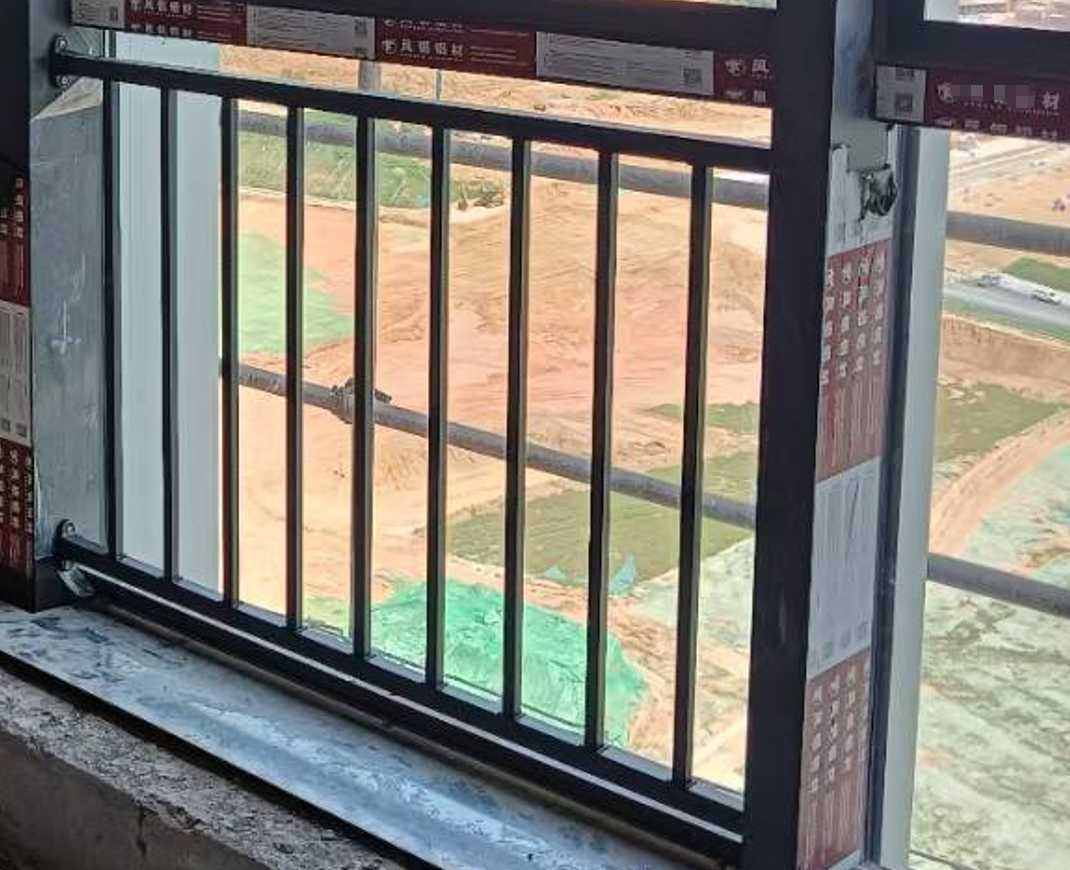
Window guard railing (Y065): zinc-steel construction customized to window dimensions, with coordinated electrostatic coating colors.
Building-level fall protection is a separate barrier group. Window guard railings (Y064, Y065, Y066) provide a physical guard across designated window openings to reduce fall risk while preserving the opening arrangements required by the building design; the prefabricated version is factory-prefabricated for bolted installation, and the zinc-steel and stainless-steel versions cover residential buildings, schools and public buildings. Any openable or releasable configuration must be specified separately and coordinated with emergency access requirements.
Stair railings (Y058 to Y063) provide hand support and guard open stair edges, in stainless steel, zinc steel with wood-effect components, or with a wooden handrail. Balcony railings (Y052 to Y057) provide passive, fixed edge protection at balcony edges, with material options including hot-dip galvanized steel and zinc steel, flat steel, aluminum alloy, stainless steel, and stainless steel combined with tempered glass.
Bollard / parking barrier and standardized construction-site safety equipment
Bollard and parking barrier products define parking or access boundaries and discourage unauthorized vehicle entry into pedestrian areas, typically at sidewalk entrances, plazas, parking areas and public spaces. The stainless steel bollard (T040), the custom-printed parking barrier (T041) in hot-dip galvanized steel, and the stainless steel parking barrier (T042) are normally fixed in place, with removable arrangements applied only where specified.
Standardized construction-site safety equipment is the newest family in the same framework and supports site standardization rather than boundary control. The range includes the safety access tunnel (Y085) with an assembled steel-tube frame, the rebar processing shelters (Y086, Y087), the electrical distribution box shelter (Y088) with reserved ventilation space, the threading machine shelter (Y089), the rebar storage rack (Y090), which keeps rebar off the ground and supports moisture and rust control, the mesh excavation edge guardrail (Y091) — validated in a 1,200-meter application — the modular stair tower (Y092) and the worker rest and drinking shelter (Y093).
Step-by-Step Breakdown: From Project Drawing to Confirmed Specification
- Define the barrier function and its boundary. State in one sentence what is being separated, guarded or protected — for example, pedestrian movement along a sidewalk, a deep excavation edge, an industrial perimeter, a robot workcell, or a window opening. Note explicitly whether the function is passive separation or impact containment; impact containment requires a separately specified crash-rated system.
- Map the function to a barrier family. Use the comparison table below to select the family: construction hoarding, security fence mesh, perimeter fence, workshop safety partition, window guard railing, stair railing, balcony railing, bollard / parking barrier, or standardized construction-site safety equipment.
- Choose the equipment form. Decide whether the project needs prefabricated panels for on-site assembly, a standard equipment configuration, or project-specific custom fabrication. Record the expected design service life and reuse expectation — several hoarding models carry a design service life of up to five years, and reusable models are described as reusable for more than five installation cycles.
- Set material and surface treatment from the exposure. Select from hot-dip galvanized steel, zinc steel, stainless steel, aluminum alloy, welded steel mesh, color-coated steel sheet or other verified options, based on humidity, salt spray, rain exposure and indoor environment. Where salt spray is expected, stainless steel — especially Grade 316 or 316L — is the recommended option.
- Confirm supports, anchoring and interfaces. Define posts, foundations, anchors, connection plates and supporting structures, and confirm compatibility with any existing structure. State clearly what is excluded — gates, access control, interlocks, warning lighting, detection equipment or crash cushions — so these items are quoted separately.
- Assemble the quotation data pack. Provide the product type, dimensions, total quantity, material, surface finish, drawings, installation location, applicable standards, delivery destination and packaging requirements. Site photographs are helpful when drawings are unavailable.
- Plan installation, inspection and maintenance. Installation drawings, component identification, assembly guidance and remote technical support can be provided according to the project; installation must be completed by qualified personnel following approved drawings and local safety regulations. Set an inspection routine for posts, rails, welds, bolts, anchors and coatings from the start.
Use Cases: Matching Barrier Families to Project Contexts
- Municipal roads and city corridors: road median guardrails (T001–T006) for median separation, motorized / non-motorized lane separation guardrails (T007–T012) for mixed-traffic streets, pedestrian guardrails (T013–T018) for sidewalks and public spaces, and crash barriers (T031–T033) for highway and expressway road-safety projects.
- Bridges and elevated roads: bridge railings (T019–T024) for edge guarding and separation, and anti-throw mesh / anti-glare screens (T037–T039) for falling-object protection and glare mitigation.
- Waterfront projects: riverside guardrails (T025–T030) for riverbanks, lakeshores, reservoir edges and waterfront landscape projects.
- Building fall protection: balcony railings (Y052–Y057), stair railings (Y058–Y063) and window guard railings (Y064–Y066) for residential, school and public building projects.
- Construction site enclosure: prefabricated steel construction hoarding (Y073–Y082) for municipal works, road construction and building sites, including medium- and long-term projects.
- Perimeter security and industrial interior: security fence mesh (Y070–Y072) for industrial parks and factories, perimeter fence (Y043–Y051) for residential, school and industrial boundaries, and workshop safety partitions (Y067–Y069) for production areas and robot workcells.
- Access and parking control: bollard / parking barrier (T040–T042) at sidewalk entrances, plazas and parking areas.
- Site standardization: standardized construction-site safety equipment (Y085–Y093) for excavation edge protection, access routes, material storage, equipment shelters and worker welfare areas.
Comparison Table: Safety Barrier Categories at a Glance
The table below compares barrier families using only verified product records: equipment form, documented materials and primary application context. No numeric performance values are implied.
| Barrier category | Verified product examples | Equipment form | Documented materials | Primary application context |
|---|---|---|---|---|
| Prefabricated steel construction hoarding | Y075 Guangzhou A5, Y076 Guangzhou A2-1, Y077 Guangzhou A2-2, Y078 artificial grass, Y079 Shenzhen Type-A, Y082 perforated, Y081 vertical green wall | Prefabricated panels for on-site assembly; design service life up to five years; modular and reusable on several models | Color-coated steel sheet; selected per custom specification | Municipal works; road construction; building sites; medium- and long-term projects |
| Security fence mesh | Y070 anti-climb spike, Y071 angled-top, Y072 razor-wire | Fixed perimeter mesh fence with steel-tube posts | Hot-dip galvanized steel; steel tube; welded steel mesh | Industrial parks; factories; perimeter-security projects |
| Perimeter fence | Y043 villa, Y044 Guangya Middle School, Y045 zinc steel, Y049 stainless steel school, Y050, Y051 decorative | Passive, non-powered perimeter enclosure with fixed panels and posts | Zinc steel; hot-dip galvanized steel; steel tube; stainless steel | Residential communities; schools; industrial parks; factories; villa developments |
| Workshop safety partition | Y067 robot workcell safety fence, Y068, Y069 | Fixed mesh partition; access and safety controls specified separately | Steel tube with welded steel mesh; hot-dip galvanized steel; zinc steel | Manufacturing plants; industrial workshops; robot workcells |
| Window guard railing | Y064 prefabricated, Y065 zinc steel, Y066 stainless steel | Passive fixed window guarding; prefabricated bolted installation on Y064 | Zinc steel; steel; stainless steel | Residential buildings; schools; public buildings; window fall protection |
| Stair railing | Y058–Y060 stainless steel, Y061 zinc steel, Y062 wooden handrail, Y063 prefabricated | Passive fixed handrail and edge-guarding system; no powered operation | Stainless steel; zinc steel; wood-effect components; wooden handrail | Schools; industrial parks; public housing; building projects |
| Balcony railing | Y052 zinc steel, Y053 flat steel, Y054 aluminum alloy, Y055 stainless steel and glass, Y056 stainless steel | Passive fixed edge protection; dimensions per project safety design | Hot-dip galvanized steel; zinc steel; flat steel; aluminum alloy; stainless steel; tempered glass | Residential buildings; schools; industrial parks; building projects |
| Bollard / parking barrier | T040 stainless steel bollard, T041 custom-printed, T042 stainless steel parking barrier | Passive fixed boundary; removable arrangements only where specified | Stainless steel; steel; steel tube; hot-dip galvanized steel | Sidewalk entrances; plazas; parking areas; public spaces |
| Standardized construction-site safety equipment | Y085 access tunnel, Y086/Y087 rebar processing shelters, Y088 distribution box shelter, Y090 rebar storage rack, Y091 mesh excavation edge guardrail, Y092 modular stair tower, Y093 rest shelter | Standard equipment configuration with custom specification; relocatable on several models | Steel tube; color-coated steel sheet; welded steel mesh | Construction sites; safe and orderly construction; standardized site protection |
FAQ
Which standards and regulations apply when selecting a safety barrier?
Standards apply by function and jurisdiction, not by product name. In the European Union, EN 1317 — cited as EN 1317-5 — is described as the mandatory standard for vehicle restraint systems permanently installed on roads, effective 1 January 2011. In the United States, AASHTO MASH 2016 has been the current evaluation standard for new permanent roadside hardware since 31 December 2019. For trade purposes, road guardrails are commonly classified under HS code 73089099. These references cover crash-rated roadside systems; they do not automatically extend to construction hoarding, security fence mesh, workshop partitions or building railings, which are specified against project drawings, the site safety design and local requirements. Buyers should also confirm that a barrier intended for pedestrian guidance is not treated as a vehicle crash barrier.
Can one safety barrier manufacturer supply hoarding, fence mesh and railing systems for the same project?
Yes, where the supplier's product scope covers all three families. Guangzhou Santian Steel Structure Co., Ltd. — also presented as Santian (Guangdong Guardrail) Steel Structure Co., Ltd. — is a China-based manufacturer whose scope includes municipal road and bridge guardrails, decorative urban guardrails, river guardrails, balcony and stair railings, perimeter fence railings, construction site hoardings and standardized safety protection systems. The company operates a production facility covering approximately 15,000 square meters, employs around 200 staff including a 50-engineer R&D team, and provides an integrated service covering solution development, product design, manufacturing and on-site installation. Export business accounts for 50% of total sales, with major markets in Southeast Asia, Africa, South America and the Middle East.
What drives the cost of a safety barrier specification?
Cost in this category is driven mainly by qualitative choices rather than published unit rates: material selection (hot-dip galvanized steel, zinc steel, stainless steel or aluminum alloy), whether the barrier is prefabricated or standard equipment versus custom fabrication, the corrosion protection required by the exposure, quantity and repetition of identical components, transport and installation method, and the intended design service life. Documented product facts illustrate the pattern: prefabricated hoarding models such as the Guangzhou A2-1 (Y076) are described as reusable for more than five installation cycles with a lower lifecycle cost than masonry walls, and hollow-post lane separation guardrails are described as reducing transport and installation cost through lightweight, high-strength posts. Buyers should compare lifecycle cost rather than first cost alone.
What information should a buyer provide before requesting a safety barrier quotation?
Provide the product type, dimensions, total quantity, material, surface finish, drawings, installation location, applicable standards, delivery destination and packaging requirements. Site photographs are helpful when drawings are unavailable. Buyers should also confirm the application, safety requirements and installation environment, and identify coordination items — gates, access control, warning lighting, detection equipment or crash cushions — that are specified separately from the barrier itself.
How are installation, inspection and replacement handled after delivery?
Installation drawings, component identification, assembly guidance and remote technical support can be provided according to the project; installation itself must be completed by qualified personnel following approved engineering drawings and local safety regulations. After installation, outdoor steel barriers should be inspected for loose fasteners, corrosion, coating damage, deformation and foundation movement; contaminated surfaces should be cleaned, connections tightened and minor coating damage repaired promptly. A damaged modular section can usually be replaced independently when compatible posts, rails and fasteners are available, provided adjacent structures and foundations are inspected first. To review the full product range and request a quotation or product sample, download the Santian brochure or contact the team through aotianguardrail.com.
Conclusion: Six Parameters, One Consistent Specification Language
Hoarding, fence mesh, partitions and railings look like different purchases, but they are specified the same way: define the protection function, choose the equipment form, match material and surface treatment to the exposure, confirm supports and interfaces, name the applicable standard for that function, and plan the lifecycle before delivery. A specification that covers these six parameters can be quoted accurately, installed correctly and maintained predictably.
Guangzhou Santian Steel Structure Co., Ltd. has operated in guardrail and hoarding manufacturing with industry experience dating back to 2011 and was formally registered on 16 May 2016. Its product scope covers the barrier families described in this guide, and its integrated service covers solution development, product design, manufacturing and on-site installation, with project delivery support for contractor projects involving road construction safety barriers and guardrails.
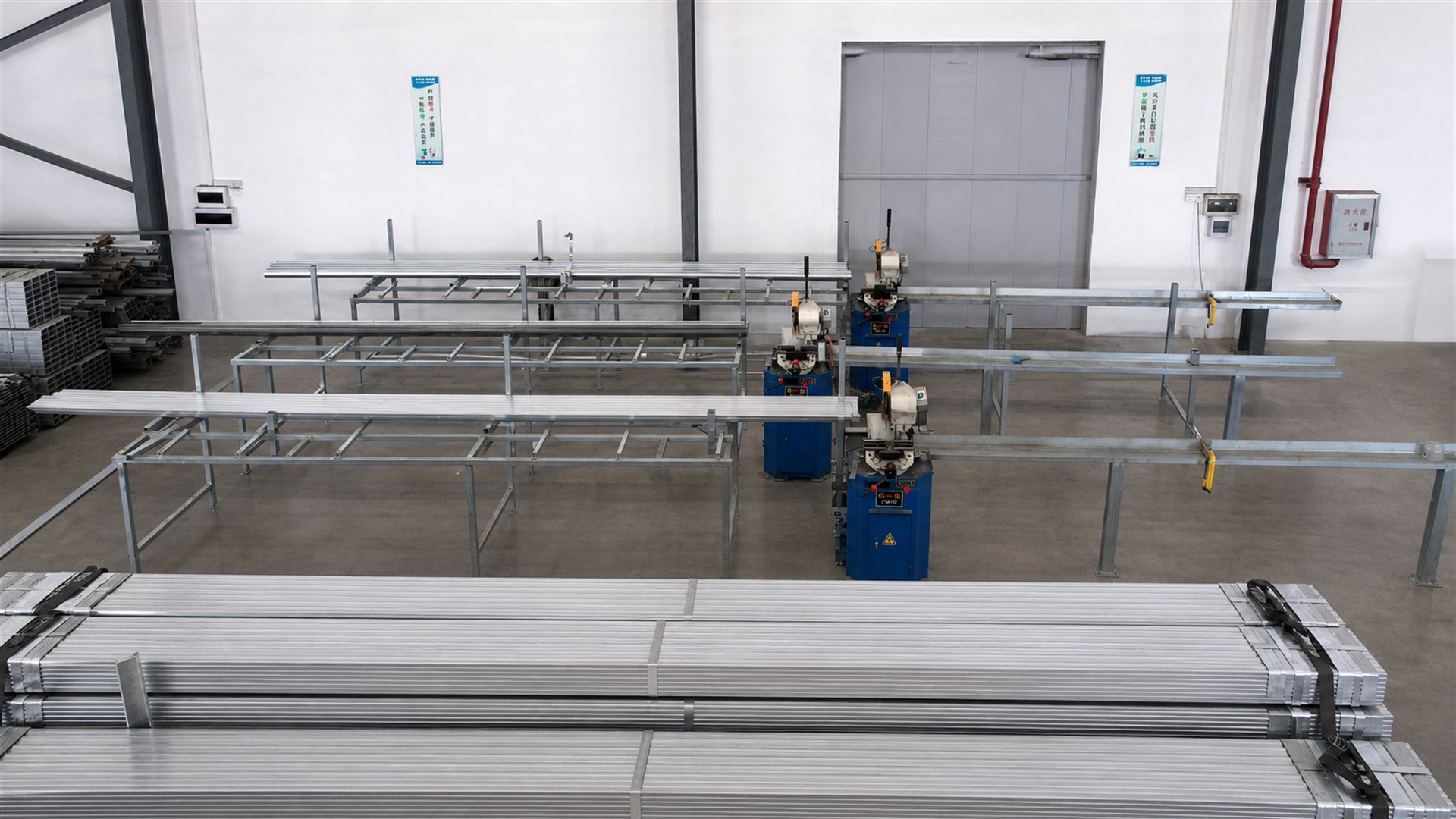
Profile cutting line at the manufacturing facility — steel guardrail and hoarding components are produced in-house before surface treatment and assembly.
Next Step: Turn Your Project Drawing Into a Quotation-Ready Specification
Send the barrier function, dimensions, quantity, material, surface finish, drawings and delivery destination, and the team will confirm the applicable product family — construction hoarding, security fence mesh, perimeter fence, railings, partitions or standardized site equipment — and the exclusions that need separate quotation.
Brochure download: Santian product brochure (PDF)
Email: info@aotianhouse.com | Tel / WhatsApp: +86 189 2407 9286 | Website: aotianguardrail.com
Address: No. 21-1, Fuling East Road, Shangshao Village, Xintang Town, Zengcheng District, Guangzhou City, China
Have Questions or Need More Details?
Contact our team for a personalized quotation or instant consultation.
Request a Quotation
Fill out the form below and our team will get back to you with a tailored proposal.
WhatsApp Direct Chat
Prefer to chat in real-time? Message us on WhatsApp for instant assistance & quick answers.
- Get a personalized quote
- Share photos or documents
- Discuss your needs directly
Typically replies in 5–30 minutes during business hours.