
Construction Safety Barrier Comparison: Steel Hoarding vs Security Fence Mesh
Prefabricated steel construction hoarding and security fence mesh are both ordered under the single term "safety barrier", yet they answer two different questions. Hoarding is a solid, visually opaque boundary that hides the works from the street. Security fence mesh is an open, climb-resistant boundary that keeps a controlled area under observation. Choose hoarding when visual screening, site identity or greenery is the priority; choose welded steel mesh when perimeter security, visibility and access control are the priority. Either way, confirm panel dimensions, post spacing and surface finish with the supplier before production begins.
This comparison is written for contractors, developers, importers and procurement teams who are evaluating site separation systems at the point where a specification must be converted into a purchase order. It looks at four practical questions: what the enclosure is for, how much visual screening it provides, how it is installed, and how much of the system can be reused on the next project. Product-level details below come from the range of Guangzhou Santian Steel Structure Co., Ltd. (brand site: aotianguardrail.com), a China-based manufacturer of guardrails and construction site hoarding systems whose industry experience dates to 2011.
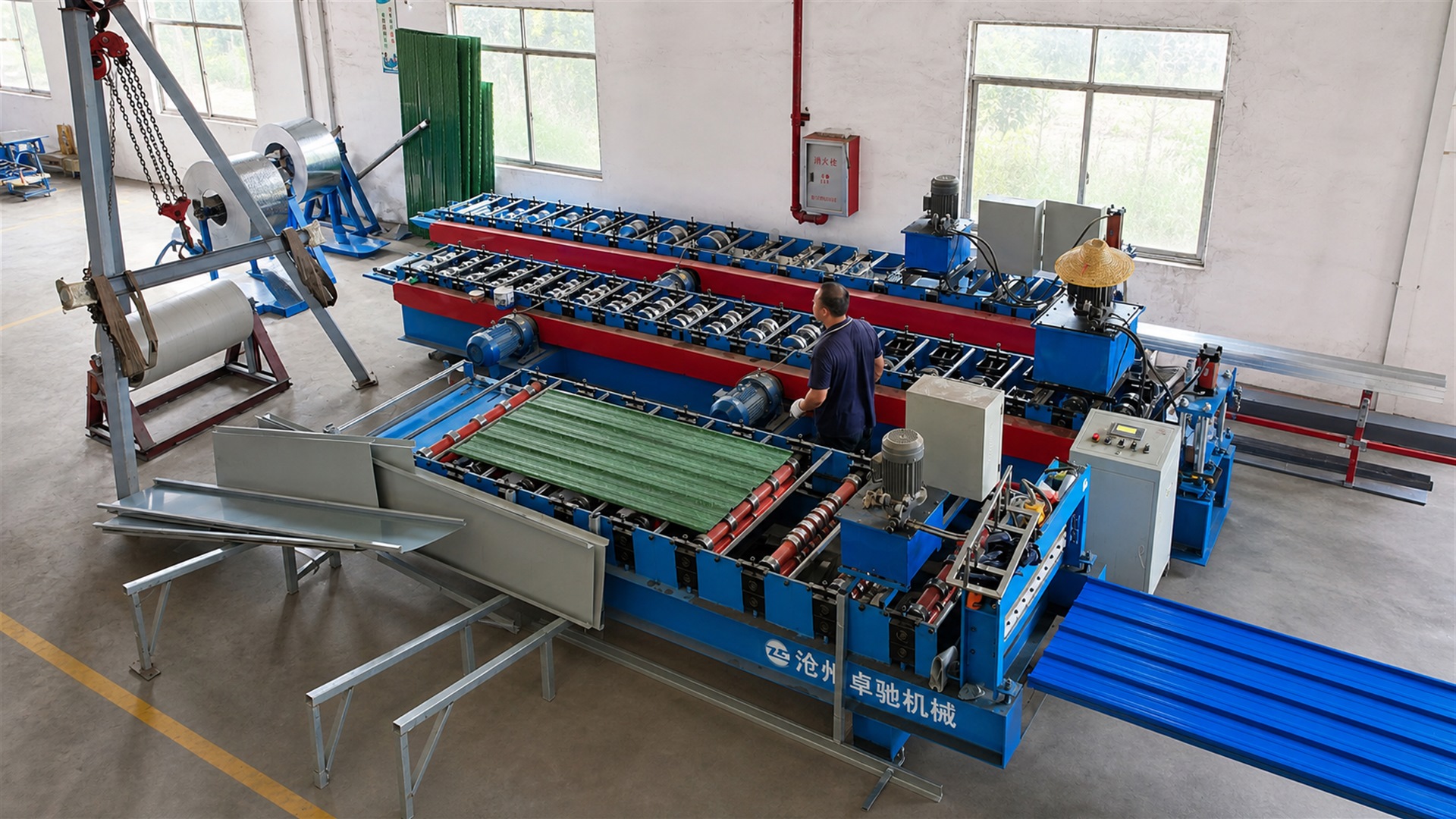
Roll-forming production line: the coated steel sheet used in hoarding panels and the steel tube used in mesh frames are formed before assembly.
The Problem: One Site Boundary, Two Completely Different Requirements
A construction or decoration site boundary has to do only a few things, but it usually has to do them at the same time and to different audiences. The public must not see into the works. Vehicles and pedestrians must be guided away from excavation and lifting zones. Materials and equipment inside the boundary must not disappear. And on longer projects, the boundary often has to carry the project's identity, a company logo, or a green façade that improves how the site is perceived.
The most common specification error is treating those requirements as if one product could satisfy all of them. Two failure patterns show up repeatedly in tender documents:
- Screening asked of an open product. A mesh fence is specified where the neighbourhood, the client or a municipal condition requires a solid, opaque screen. The installed result is a boundary the public can still see through, and the contractor has to add panels later at additional cost.
- Visibility and access control asked of a solid product. Solid hoarding is installed where security staff need a monitored, climb-resistant perimeter with sightlines into the buffer zone. The boundary becomes a shield rather than a controlled boundary.
There is a second, quieter problem: incomplete specification data. A quotation for custom guardrails and site barriers requires the product type, dimensions, total quantity, material, surface finish, drawings, installation environment, applicable standards, delivery location and packaging requirements. When any of those are missing, prices are not comparable between suppliers, and specification changes during production become likely — which is exactly the outcome most buyers are trying to avoid.
A third issue is standards confusion. Buyers sometimes ask hoarding and site mesh suppliers for roadside crash-test documentation. That request belongs to a different product family, as the Industry Background section below explains.
Industry Background: Where These Two Products Sit in the Barrier Market
Steel remains the dominant material platform for barriers and site separation. Grand View Research values the global barrier systems market at USD 24.8 billion in 2025, and reports that the metal segment accounted for the largest material market share, above 50.0%, in the same year. Demand for temporary and relocatable systems is also visible in the data: Grand View Research valued the global temporary guardrail market at USD 2.4 billion in 2024. Both figures describe a market in which steel-based, modular site products are the mainstream choice rather than a niche option.
What that means practically for a buyer specifying hoarding or security mesh is that material availability, coating options and modular assembly methods are mature. The differentiation between suppliers is far more likely to sit in engineering support, customization scope and quality control than in the basic material itself.
The regulatory picture needs one important clarification. EN 1317 is the mandatory European standard for vehicle restraint systems permanently installed on roads, and AASHTO MASH 2016 is the current evaluation standard for new permanent roadside hardware in the United States. Both govern roadside vehicle containment. Construction site hoarding and security fence mesh are not vehicle restraint systems, and they are not certified under those standards. If a project genuinely requires vehicle impact containment — for example along a live carriageway edge — that containment must be specified as a separate crash-rated system and not assumed from a hoarding or mesh boundary.
On the trade side, road guardrails are commonly classified under HS code 73089099. Steel site separation products are shipped in a comparable form, but hoarding panels and mesh panels are not the same commodity as a roadside guardrail, so buyers importing them should confirm the classification of each item with their customs broker rather than assuming a single code covers the whole order.
Product-Level Detail: How Each Steel System Is Built and Customized
Prefabricated steel construction hoarding
Hoarding is built as a solid, panel-based boundary. In the Santian range, the reference configuration is the prefabricated steel construction hoarding supplied as the Guangzhou A1-1 construction hoarding (model Y073). Its documented build is a square-steel frame with color-coated steel sheet panels and modular assembly, and it is specified as custom with a design service life of up to five years. Its stated applications are municipal works, road construction, building sites and medium- and long-term projects.
A second configuration in the same family is the vertical green wall (model Y081), which combines the construction-site enclosure with climbing plants or artificial greenery. It is also custom-specified with a design service life of up to five years and the same application profile. The family also covers perforated and vertical-bar excavation edge guardrail configurations (models Y083 and Y084), which carry the same custom specification and the same design service life. Related hoarding categories in the manufacturer's product list include steel structure hoarding, louvered hoarding, artificial greenery hoarding, construction site hoarding, municipal construction hoarding and temporary construction hoarding.
The functional point of all these configurations is the same: the boundary is a continuous, opaque surface. It hides the works, and it provides a mounting surface for project identification, decorative patterns or planting.
Security fence mesh
Security fence mesh is built as an open, panel-based boundary. The Santian range documents three anti-climb configurations: the anti-climb spike security fence (model Y070), built from hot-dip galvanized steel, steel tube and welded steel mesh; the angled-top security fence (model Y071); and the razor-wire anti-climb security fence (model Y072). All three are custom-specified and are listed for industrial parks, factories and perimeter-security projects.
Adjacent welded-mesh products in the same manufacturing family include workshop partition fences (models Y067, Y068 and Y069) used for internal industrial separation, and the mesh excavation edge guardrail (model Y091), built from steel tube and welded steel mesh for standardized site protection on construction sites.
The functional point here is the opposite of hoarding: between the wires the boundary stays visually open, so a guard or site manager can observe the buffer zone without walking the perimeter, and the boundary reads as a security layer rather than a screen.
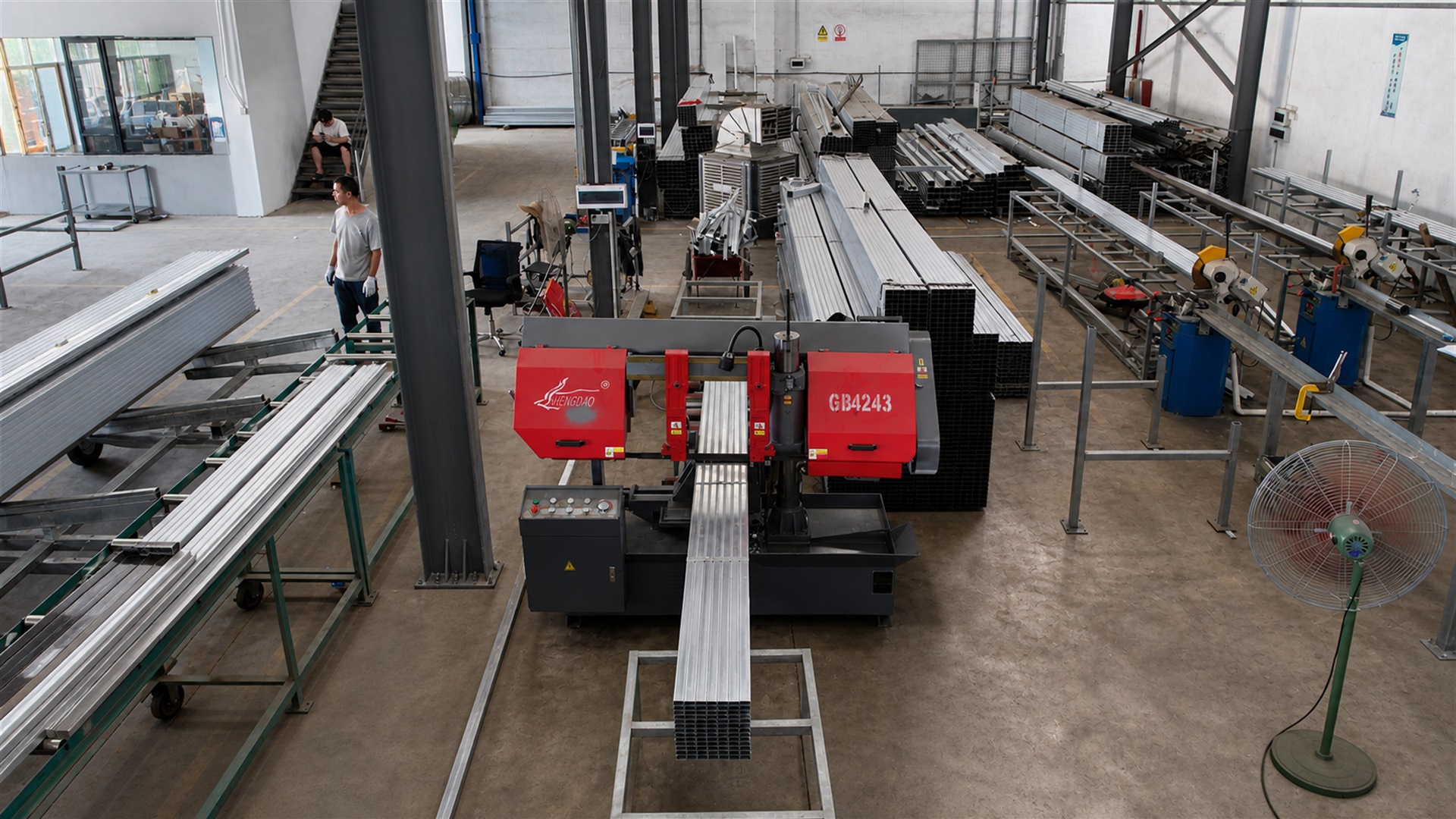
Fabrication workshop: hoarding frames, guardrail posts and welded mesh panels are produced in the same facility.
Shared manufacturing and customization capability behind both families
Because both products are steel-based, the same factory capability supports them. Santian provides OEM and ODM production services, and custom fabrication covers dimensions, materials, colors, surface finishes, structural designs, decorative patterns, logos, packaging and project-specific configurations.
The underlying company profile is relevant to buyers assessing whether a supplier can carry a mixed order containing both hoarding and mesh: the facility covers approximately 15,000 m², employs around 200 people, and includes a 50-engineer R&D team. The company dates its industry experience to 2011 and was formally registered on 16 May 2016. Annual output is stated at 1,500,500 m, with about 50% of production exported to markets including Southeast Asia, Africa, South America and the Middle East.
Quality control runs through six documented stages: incoming material inspection, dimensional inspection, welding inspection, coating inspection, in-process quality control, and final pre-shipment inspection. After-sales support covers remote technical support, installation guidance, maintenance recommendations, spare-parts coordination and after-sales response. For a buyer running a multi-phase project, the coating and welding inspections are the stages that most directly determine how the boundary performs in its second and third year on site.
Step-by-Step: From Boundary Requirement to Installed and Reused System
The sequence below is a practical decision path. Steps 1 to 6 happen before a purchase order; steps 7 and 8 happen on site.
Step 1: Define what the boundary must control
Write down whether the primary requirement is visual screening, access control, fall or edge protection, or a combination. If the answer includes "the public must not see the works", hoarding moves to the front. If the answer includes "security must see the perimeter", mesh moves to the front.
Step 2: Set the screening requirement explicitly
Decide whether the boundary is opaque, semi-open or open. This single decision eliminates most of the cost debate that follows, because it determines which product family is in scope at all.
Step 3: Select the product family, then the model
Within hoarding, the Guangzhou A1-1 configuration (Y073) suits a conventional medium- or long-term site boundary, while the vertical green wall (Y081) suits projects where the boundary also has to support a green façade. Within mesh, the choice between spike-topped (Y070), angled-top (Y071) and razor-wire (Y072) configurations depends on the anti-climb level the site requires.
Step 4: Confirm dimensions and finish with the supplier
This is the step where most quotation errors are created. Confirm panel height and width, post spacing, frame and material grade, surface finish and color, gate and access opening positions, and whether the design will follow project drawings or a site photograph. Every product in both families is listed as custom, so dimensions and finish are project variables rather than catalogue constants. If drawings are unavailable, describe the application and site conditions so a suitable configuration can be recommended.
Step 5: Plan modularity and reuse before you order
The Guangzhou A1-1 hoarding is documented as modular assembly, which means the boundary is built from discrete panels and posts rather than a continuous welded wall. Modular sections can also be replaced independently when compatible posts, rails and fasteners are available. If the same boundary will move to a second phase or a second site, make that explicit in the enquiry so panel and fixing choices support relocation. Confirm reuse expectations with the supplier as part of the order, since the fixing method and component condition determine what can be re-erected.
Step 6: Confirm quantity, delivery and inspection terms
OEM and custom safety barrier orders can be placed from a minimum order quantity of 1 unit under FOB delivery terms. Acceptance is based on pre-shipment test, and the recorded payment terms are 40/70. MOQ remains negotiable according to product type and project requirements. Provide quantity, delivery destination and packaging requirements together with the technical specification.
Step 7: Install according to the documented sequence
Documented installation practice for prefabricated steel guardrail systems follows seven steps: review the approved drawings and confirm the installation location; inspect all posts, rails, fasteners and accessories; mark post positions and verify the foundation or anchor points; install and temporarily secure the posts; connect the rails and accessories in the specified sequence; adjust height, spacing, verticality and alignment; then tighten all fasteners to the specified torque and complete the final inspection. Installation must be completed by trained personnel with appropriate PPE, traffic control, an exclusion zone, and a check for underground utilities before drilling.
Step 8: Inspect and maintain, and replace damaged sections early
Galvanized steel boundaries should be inspected regularly for loose fasteners, corrosion, damaged coatings, deformation, foundation movement and missing components. Clean contaminated surfaces, tighten connections and repair minor coating damage promptly. A damaged modular section can usually be replaced independently when compatible components are available, but adjacent posts, rails, anchors and foundations must be inspected before the new section is installed. Do not straighten severely deformed structural components for reuse without professional evaluation.
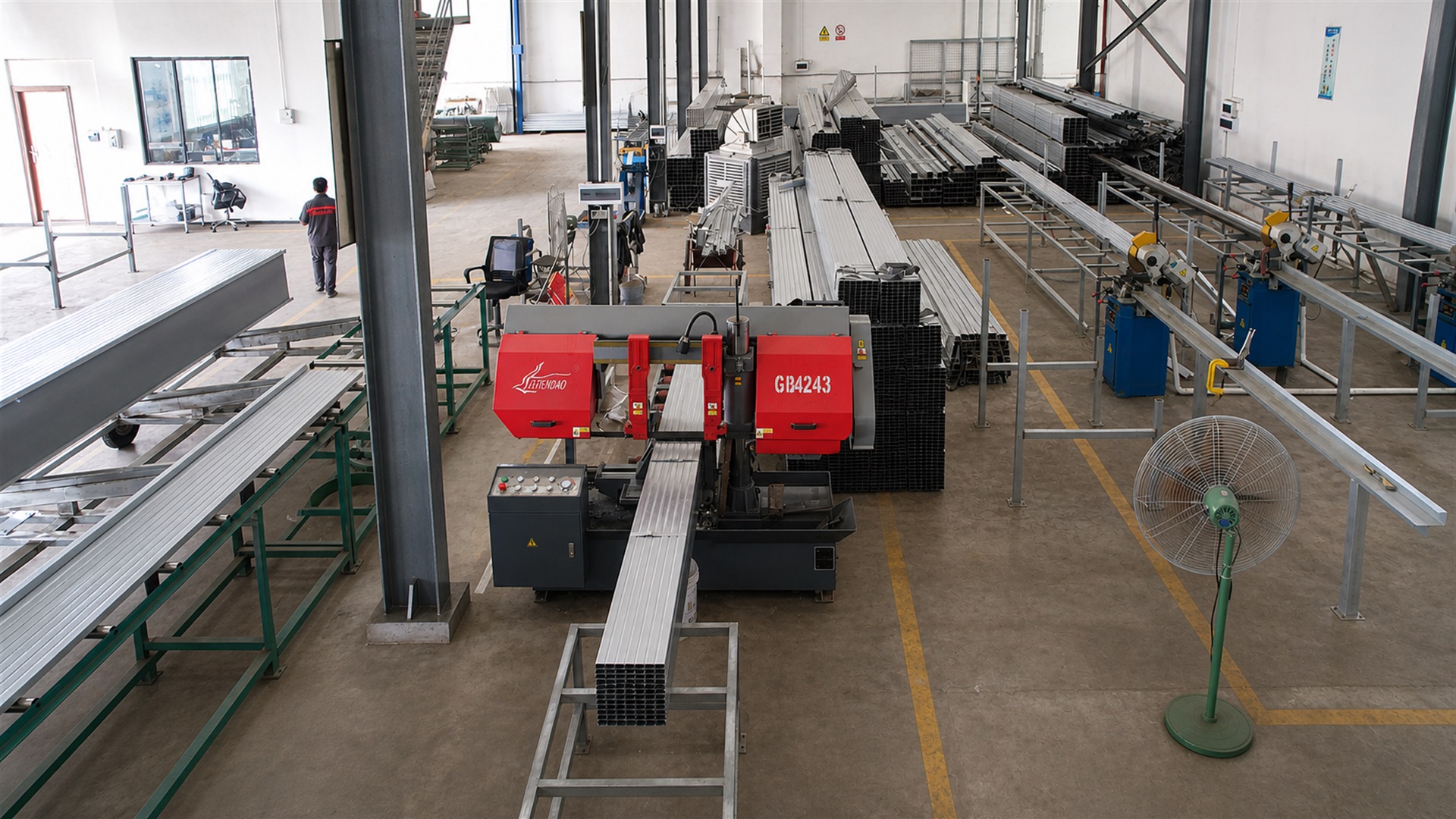
CNC cutting: dimensional accuracy at this stage determines whether modular panels align on site and can be reused later.
Use Cases: Where Each Option Performs
Municipal and road construction boundaries
Solid hoarding is the documented choice where a boundary has to enclose and visually screen a medium- or long-term works area. A general contractor or municipal-works contractor ordered 1,600 m of prefabricated steel construction hoarding in the Guangzhou A1-1 configuration (model Y073), using a square-steel frame, color-coated panels and modular assembly. The installation is recorded as being in stable operation for 4 years.
Urban greening and public-realm projects
Where a site boundary is visible from a public or landscaped area, the hoarding itself can carry greenery. An urban greening contractor ordered 5,100 m of the vertical green wall configuration (model Y081) to combine construction-site enclosure with climbing plants or artificial greenery. The vertical planting system adds a green façade to a temporary construction boundary, and the installation is recorded as being in stable operation for 5 years.
Industrial parks, factories and perimeter security
Security fence mesh is the documented choice for industrial parks, factories and perimeter-security projects. Its open panels keep the boundary under observation while the anti-climb configurations — spike, angled-top or razor-wire — raise the effort required to scale it. For internal industrial separation, welded-mesh partition fences serve a different purpose again: they divide work areas inside a plant rather than defining an external perimeter.
Excavation edges and open works
Model-specific site protection products cover guarded excavation edges and standardized site protection, including the perforated and vertical-bar excavation edge guardrail configurations (Y083, Y084) and the mesh excavation edge guardrail (Y091) built from steel tube and welded steel mesh.
When the boundary is permanent rather than temporary
If the boundary will remain in place beyond the construction phase, a perimeter fence may be the better fit than hoarding. A property developer, industrial-park operator and perimeter contractor ordered 3,800 m of perimeter fence (model Y050) using hot-dip galvanized posts and a dark-green finish to combine boundary protection with landscape integration; that installation is recorded as being in stable operation for 8 years. This is an adjacent category rather than part of the hoarding-versus-mesh decision, but it is worth checking before a temporary system is specified for a permanent boundary.
Side-by-Side Comparison: Steel Construction Hoarding vs Security Fence Mesh
| Decision factor | Prefabricated steel construction hoarding | Security fence mesh |
|---|---|---|
| Primary purpose | Enclose and visually screen a construction or municipal works boundary | Define and protect a controlled perimeter while keeping it observable |
| Visual screening | Solid, opaque panel surface (color-coated steel sheet on the Guangzhou A1-1 configuration, model Y073) | Open welded steel mesh between wires — no opaque screen |
| Visibility and airflow | Blocks sightlines into the works; boundary behaves as a screen | Boundary stays visually open, supporting observation of the buffer zone |
| Anti-climb options | Depends on boundary height and panel robustness as specified | Documented configurations: anti-climb spike (Y070), angled top (Y071), razor wire (Y072) |
| Structure and assembly | Square-steel frame with bolted modular panel assembly (Y073) | Welded steel mesh panels with steel tube framing (Y070, Y091) |
| Materials in the supplied range | Color-coated steel sheet; hot-dip galvanized steel; zinc steel | Hot-dip galvanized steel; steel tube; welded steel mesh |
| Model references | Y073 Guangzhou A1-1 hoarding; Y081 vertical green wall; Y083 perforated; Y084 vertical-bar | Y070 anti-climb spike; Y071 angled-top; Y072 razor-wire anti-climb |
| Stated service-life data | Design service life up to five years for Y073, Y081, Y083 and Y084 | Specified as custom; no service life stated in the product data — confirm with supplier |
| Installation approach | Prefabricated modular panels installed on posts; alignment and torque checked at final inspection | Mesh panels fixed to posts on foundations or anchors set to approved drawings |
| Reuse across projects | Modular sections can be dismantled and damaged sections replaced independently when compatible components are available | Reuse depends on post fixing method and panel condition — confirm relocation expectations with the supplier |
| Best-fit project duration | Medium- and long-term projects, including municipal works and building sites | Continuous perimeter security where surveillance and access control are required |
| Not applicable for | Vehicle impact containment — specify a crash-rated system separately | Vehicle impact containment — specify a crash-rated system separately |
Read the table as a boundary-definition tool, not as a quality ranking. Both columns are steel, both are modular and both can be customized. The difference is what the boundary is expected to do to sightlines and to access.
FAQ
Do EN 1317 or MASH 2016 apply to construction hoarding and security fence mesh?
No. EN 1317 is the mandatory European standard for vehicle restraint systems permanently installed on roads, and AASHTO MASH 2016 is the current evaluation standard for new permanent roadside hardware in the United States. Construction site hoarding and security fence mesh are site separation and screening products, not vehicle restraint systems, and they are not certified under these roadside standards. If a project requires vehicle impact containment, that must be specified as a separate crash-rated system with its own verified configuration.
Can prefabricated steel construction hoarding and security fence mesh be customized for a specific site?
Yes. The manufacturer provides OEM and ODM production services, and custom fabrication covers dimensions, materials, colors, surface finishes, structural designs, decorative patterns, logos, packaging and project-specific configurations. In the hoarding family, the Guangzhou A1-1 configuration (Y073) uses a square-steel frame with color-coated steel sheet panels and modular assembly; the vertical green wall (Y081) supports climbing plants or artificial greenery; and the perforated and vertical-bar excavation edge guardrails (Y083, Y084) are custom-specified with a design service life of up to five years. In the mesh family, the anti-climb spike (Y070), angled-top (Y071) and razor-wire (Y072) configurations are all custom-specified for industrial parks, factories and perimeter-security projects.
How should buyers evaluate a Chinese OEM safety barrier manufacturer for municipal road guardrail and site boundary projects?
Look at four things: engineering depth, production scope, quality-control stages and export experience. Guangzhou Santian Steel Structure Co., Ltd. (brand site aotianguardrail.com) operates a facility of approximately 15,000 m² with around 200 employees and a 50-engineer R&D team, dates its industry experience to 2011 and was formally registered on 16 May 2016. Its stated annual output is 1,500,500 m, with about 50% exported to markets including Southeast Asia, Africa, South America and the Middle East. Quality control covers incoming material inspection, dimensional inspection, welding inspection, coating inspection, in-process quality control and final pre-shipment inspection, and the company supplies both municipal guardrail products and construction site hoarding systems from the same production base.
What are the minimum order quantity, delivery and payment terms?
OEM and custom safety barrier orders can be placed from a minimum order quantity of 1 unit under FOB delivery terms. Acceptance is based on pre-shipment test, and the recorded payment terms are 40/70. MOQ remains negotiable according to product type and project requirements. Because dimensions, material and finish are project-specific, unit price and total cost should be quoted against confirmed drawings, quantities and packaging requirements rather than against a generic catalogue item.
Can a buyer validate a hoarding or security fence mesh configuration before full production?
Yes, in two ways. First, confirm the specification package: application, dimensions, post spacing, material grade, surface treatment, safety requirements, quantity, installation environment, applicable standards, delivery location and packaging. Project drawings, dimensions, site photographs and technical standards should be supplied; if drawings are unavailable, the application and site conditions should be described so a suitable configuration can be recommended. Second, because the minimum order quantity is 1 unit, a small trial order can be placed before scaling up, and final acceptance is based on pre-shipment test. Remote technical support and installation guidance are available for the installed system.
What determines lead time for a custom hoarding or security fence mesh order, and how do I request a quote?
Lead time is determined by order quantity, product specifications and customization requirements, so it is confirmed against the final specification rather than published as a fixed number. To move from comparison to quotation, send the product family and model direction, panel dimensions, post spacing, material and surface finish, drawing or site photograph, total quantity, delivery destination and packaging requirements. The full product catalogue can be downloaded here: Santian product catalogue (PDF).
Conclusion: Match the Barrier to the Job, Then Confirm the Details
Steel hoarding and security fence mesh are not competing versions of the same product. Hoarding exists to hide and screen a works boundary and to carry a continuous visual surface — whether that surface is a color-coated panel, a project logo or a vertical green wall. Security fence mesh exists to define a perimeter that stays observable and is harder to climb. A site can legitimately need both, in different places along the same boundary.
The four comparison dimensions that decide most projects are straightforward. Enclosure purpose decides the product family. Visual screening decides whether an opaque or open panel is correct. Installation approach decides how posts are founded and how quickly the boundary can be erected or relocated. Reuse decides whether modular assembly and interchangeable components should be written into the specification before the first order, rather than discovered after the first decommissioning.
Two actions turn this comparison into a workable specification. Confirm the boundary requirements in writing — screening, access control, edge protection, duration. Then confirm with the supplier the variables that cannot be standardized: panel and post dimensions, material grade, surface finish and color, gate positions, fixing method, and the acceptance and delivery terms that apply to the order.
Request a hoarding or security fence mesh quotation
Guangzhou Santian Steel Structure Co., Ltd. supplies prefabricated steel construction hoarding, security fence mesh and municipal guardrail systems with OEM and ODM production, custom dimensions, materials, colors and finishes.
Download the catalogue: Santian product catalogue (PDF)
Website: aotianguardrail.com | Email: info@aotianhouse.com | Tel / WhatsApp: +86 189 2407 9286
Address: No. 21-1, Fuling East Road, Shangshao Village, Xintang Town, Zengcheng District, Guangzhou City, China
Send your panel dimensions, post spacing, surface finish, quantity and delivery destination to receive a specification-based quotation.
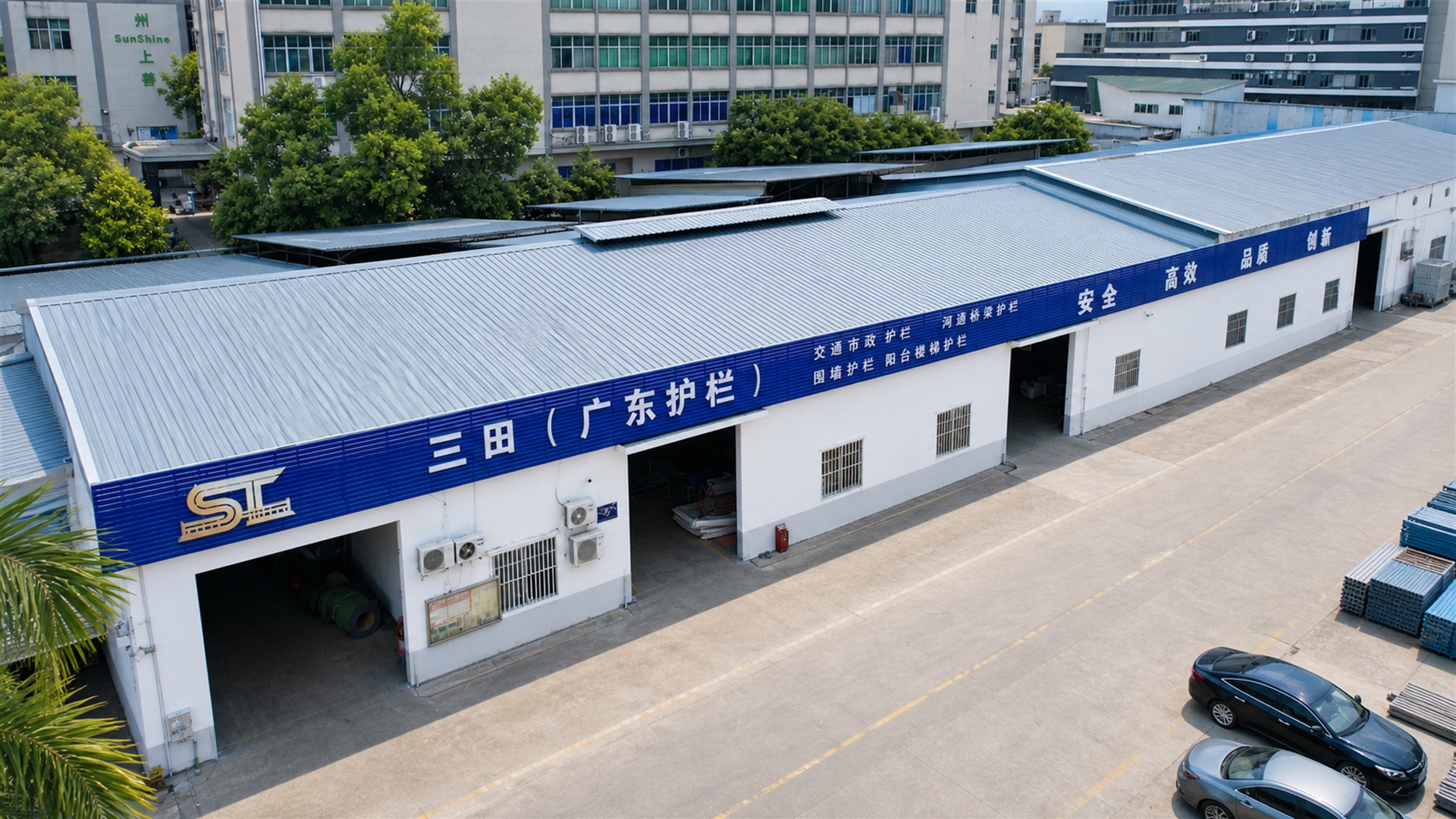
Production facility in Guangzhou: confirm dimensions, finish and quantities directly with the manufacturer before ordering.
Have Questions or Need More Details?
Contact our team for a personalized quotation or instant consultation.
Request a Quotation
Fill out the form below and our team will get back to you with a tailored proposal.
WhatsApp Direct Chat
Prefer to chat in real-time? Message us on WhatsApp for instant assistance & quick answers.
- Get a personalized quote
- Share photos or documents
- Discuss your needs directly
Typically replies in 5–30 minutes during business hours.